Category Archives: Higher Education

International Student Interview: Cross-Cultural Adaptation (Vietnam)

I’d like to thank my student Shirin Abboud for her excellent final project: International Student Interview.  I would also like to thank  Nhi (Nikki) Vuong for sharing her story with us.  Because of their hard work, we have access to the cross-cultural experiences of a UNR international student from Vietnam.  I hope that this helps students coming to America as well as educators in America better prepare for study abroad’s challenges and rewards.

Many of Nikki’s cross-cultural adaptation and transitional challenges are shared among international students.  The following key points are from the video:

  • Cross-Cultural Challenges: Language, making friends, and family separation.  She coped with language challenges by practicing with friends/teammates in addition to watching movies, writing, asking questions, and getting involved with activities to use the English language often.  She made friends by being more outgoing and getting involved with sports.  Being separated from family can be very challenging but Nikki uses social media to stay in touch.
  • Nikki came to the U.S. with her immediate family so knowing someone here is helpful but it means that there are more cross-cultural complexities that come with more people transitioning into the U.S. culture.
  • She likes the U.S. culture/friendly people/diversity
  • Study Abroad Rewards: Increases confidence, knowledge/experience, open-mindedness.  Builds friendships, language skills, cultural competencies, international experience.

To provide more stories about study abroad in America, I will post a new international student interview from a different country each week for the three weeks. Check out last week’s interview with Jiao Jiao from Beijing, China. Hope you find this helpful and please comment if you do.  Thanks.

Also, HLSL Institute is a helpful resource for international students, travelers, expatriates and expatriate families coming to the U.S.    Check it out if you want help with cultural transition, language, transportation, and acculturation development.
2 Comments

Filed under Higher Education, International Education

International Student Interview: Cross-Cultural Adaptation (Beijing, China)

I’d like to thank my student Amanda Santos for her excellent final project: International Student Interview.  I would also like to thank  Mengjiao Mi “Jiao Jiao”, for sharing her story with us.  Because of their hard work, we have access to the cross-cultural experiences of a UNR international student from Beijing, China.  I hope that this helps students  coming to America as well as educators in America better prepare for study abroad’s challenges and rewards.

Many of Jiao Jiao’s cross-cultural adaptation and transitional challenges are shared among international students.  The following key points are from the video:

  • Jiao Jiao just graduated from the University of Nevada, Reno this month! Congrats Jiao Jiao!
  • Jiao Jiao is an accomplished UNR athlete (impressive dedication for her studies and sports commitments)
  • Cross-Cultural Challenges: Language, time management, and family separation.  She coped with language challenges by practicing with friends and teammates, asking questions, and getting involved with activities to use the English language often.  She coped with balancing academic and athletic responsibilities by structuring time management skills.  Being separated from friends and family can be very challenging but she used social media to connect and stay in touch.   Time differences were an issue but staying up late or getting up early to chat was worth it.
  • Jiao Jiao came to the U.S. without knowing anyone here. (That takes courage)
  • She likes the U.S. food (except raw,cold vegetables) & U.S. culture/friendly people (but was shocked about dating culture).
  • Jiao Jiao is planning on applying to UNR’s Public Health Masters program in 2014
  • Study Abroad Rewards: Increases confidence, knowledge/experience, open-mindedness.  Builds friendships, language skills, cultural competencies, international experience.

To provide more stories about study abroad in America, I will post a new international student interview from a different country each week for the next month. Hope you find this helpful and please comment if you do.  Thanks.

Also, HLSL Institute is a helpful resource for international students, travelers, expatriates and expatriate families coming to the U.S.    Check it out if you want help with cultural transition, language, transportation, and acculturation development.

2 Comments

Filed under Higher Education, International Education

New Nevada Higher Education Funding Formula: Making International Students More of a Priority

fund form

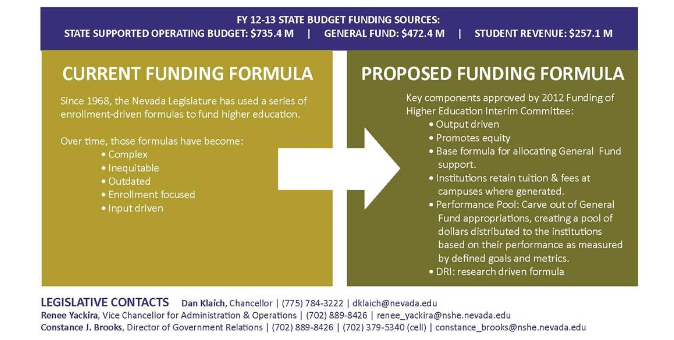
There are two aspects of the new Nevada higher education funding formula that will contribute towards a stronger demand for international students.  The first involves how Nevada college and university revenue will be calculated.  The traditional formula was based on student enrollment (colleges received funding based on the number of students who enrolled in courses).  The new funding formula is based on student completion rates (colleges receive funding based on the number of students who pass their courses). This change means that colleges and universities only get paid if the students are successful and pass a class.

(old) Enrollment rates    —>    (new) weighted student course    +   completion rates  =  Pay for performance model

1 image

This is a good change if Nevada’s colleges have high performing students who pass all their classes.  Unfortunately, research demonstrates that this is not always the case.  Out of seven public colleges and universities and a handful of private colleges in the state, in-state (resident) students only demonstrate approximately 50% graduation rates within 6 years; whereas, non-resident aliens (out-of-state/international) students demonstrate approximately 70% graduation rates.  This means that the Nevada System of Higher Education (NSHE) will collect approximately 20% more revenue from international and out-of-state students.

The second aspect of the new NV higher education funding formula that contributes towards a stronger demand for international students includes how student tuition/fees are kept on campus.  You see, in-state (resident) students pay approximately $6,500 per year whereas; non-resident aliens (out-of-state/international) students pay approximately $20,000 per year.  Nevada higher education institutions will be able to keep more of their out-of-state student tuition/fees compared to the in-state student tuition/fees based on this new formula.

Remember, higher education is a business.  If international students bring in more out-of-state tuition/revenue and are more likely to pass their courses (hence, more money), colleges and universities will undoubtedly favor and invest in international student recruitment, retention, and graduation.  This is a significant change for Nevada since for many years institutions have under-appreciated the vast diversity and globalization benefits that international students contribute to campuses and communities.  Hopefully, the unintended consequences of this new funding formula will ultimately stimulate greater research, cross-cultural support services, and international partnerships in Nevada.

23 Comments

Filed under Higher Education, International Education

Knock Knock…Who’s there? International Students and We Want Your Attention.

gradiStock_000020829404_Small

By 2025, more than 8 million students are projected to be studying abroad (outside their home country).  This increasing demand for international education presupposes a growing need for student support resources to accommodate a growing international student aggregate.  But as higher education systems struggle with state and federal disinvestment (funding and support), it will also struggle with providing necessary resources (staffing, space, funding, etc.) for student success.  In the midst of this academic conundrum, international students will seek what other options are available.  This is a problem for higher education since it already completes with public, private, online, for-profit and non-profit educational entities for quality international students.  The colleges and universities who can’t provide and support their current students won’t be able to attract/recruit new ones.

Did you know that international students have different needs than domestic/traditional students?  For example, the need for cross-cultural transition education directly impacts student performance.  Many colleges and universities don’t provide the cross-cultural support.  If it is provided, many services are often very minimal, provided long after the semester initiated, or are grant funded (which means the money can always be discontinued after the fixed contract).  This is truly unfortunate for the international student body.  Cultural differences between American college cultures and the norms of international students can influence academic success, social skills, psychological health, and professional development.

If students are not provided proper cross-cultural training before they arrive on American campuses and are not supported during post-induction cultural transitions, serious factors can derail their academic and professional goals (not to mention their overall wellness: psychological, emotional, financial, and physical wellbeing).

As higher education continues to feel the growing pains and pressures to enhance international student recruitment and retention, I believe there is a greater need to prioritize cross-cultural services.  If international students don’t experience a healthy transition, they are not as apt to succeed and pass their classes.

Leave a comment

Filed under Higher Education, International Education

Cross-cultural Adaptation

20130223-164417.jpg

A couple days ago I bumped into a previous international student in front of my office. After exchanging pleasantries, my next question startled her, “how much longer do you have before graduation and how are you liking your study abroad so far?” It must have been a sensitive issue based on her squeamish hesitation.

Sighing with exhaustion, she admitted to having another two years of college before returning to her home country. She described that she was enjoying her time in America but that it was a challenge coping with the academic and social adjustments. “I have a friend now who helps me practice speak English. There aren’t any school services that I know of to practice speaking English and American students don’t have time to help.”

I then asked if she had made many American friends. “Not really. Americans pretty much keep to themselves. It would be nice to connect with a group of friends who were patient with me. It would also be helpful if they corrected my language skills instead of letting my misunderstandings pass by. How are my communication skills going to improve if I don’t know when I’m saying something wrong?”

Of course I offered to help and reminded her that my office door (and email) were always open but this topic begs the question: “Are colleges and universities providing sufficient support services for international students and can cultural adjustment be made fun, educational, and affordable?”

I think so but it presupposes that a new investment is made in this student body and new campus services. As globalization continues to reshape higher education, we’ll all feel the impact of a new international society. Employers are hiring culturally competent applicants and educational leaders are responsible for fostering those cultural competencies. In order to generate a diverse, internationally prepared workforce, we must first address how we introduce cultural sensitivities and facilitate cross-cultural adaptation. What international student support services do you use, do you need, or would recommend trying?

3 Comments

Filed under Higher Education, Leadership

Thank to my UNR student, Alyce for her wonderful final project interviewing Young Park. The transition into a new culture can be very challenging. Young introduces us to his cross-cultural experience.


Leave a comment

Filed under Higher Education, International Education

International Student Support Services

Image Source: http://ow.ly/fNAFh

Image Source: http://ow.ly/fNAFh

Twenty-first century higher education strives to prepare an educated and civilly responsible workforce, capable of succeeding in competitive, global markets. Globalization and higher education are interdependent systems benefiting from each other’s successes as well as impacted by each other’s forgone positive contributions. Globalization is not a trend, but a growing influence reshaping college campuses and employer demands. As technology, transportation, and communication evolve, international collaboration increases; thus, presupposing a greater need for educational systems to bridge diverse cultural gaps.

Globalization and technology trends presuppose the increased need for highly skilled college graduates with intercultural communication and adaptation skills. As international student enrollment increases, there will also be increasing pressures to develop effective international student support services and the evaluation of those services while competing with for-profit and nonprofit institutions. Greater linkage between higher education student support services and international student needs will foster communication and facilitate better transition into American college cultures; ultimately strengthening international student successes.

Cross-cultural awareness + sensitivity + competencies = intercultural adaptation

Cross-cultural: researching and understanding the similarities and differences between two cultures.
Intercultural: The interaction between two cultures.

The preliminary findings from my dissertation pilot study, “International Student Perception of a Pre-Departure Cross-cultural Competency Preparation: A Phenomenological Study”, found two main themes. The first was that inbound international students need specific and unique student support services (compared to traditional students) that directly impact their academic success. The primary need was for better English speaking (not writing) services. The second was that cultural preparation strategies for international students are needed to enhance student transition into the American higher education system. Specifically, socialization or “sticky campus” strategies that increase a balanced student engagement lifestyle were addressed.

The international student perspective demonstrated that an earlier intercultural intervention could improve student cross-cultural competencies and thus, intercultural adaptation into American college cultures and their academic success. These findings should encourage college and university administrators to more intentionally and accurately address international student needs, prescribe more effective campus support services, and consider developing pre-departure cultural preparation services to better serve international students before they arrive on campus.

If you have experienced effective cultural preparation strategies or would like to recommend helpful educational strategies, please share them in the comments section below.  Thank you for visiting taramaddendent.com.

Leave a comment

Filed under Higher Education, Leadership

Student Discipline

Watch this video about school law, specifically student discipline, and participate in a discussion about policy and law.

27 Comments

Filed under Higher Education

Public School Church/State Discussion

In June 2006, (Clark County, NV) Foothill High School Valedictorian Brittany McComb delivered a Christian-laced graduation speech.

Prior to graduation day, her speech was reviewed by school officials who required edits to avoid school-sponsored promotion of a religion.  Brittany agreed to the required changes but proceeded to use her original version anyway. School officials quickly cut off McComb’s microphone, to avoid anyone getting the idea their public school was preaching Christianity.

In relation to church/state regulations in public schools, what are your thoughts about this public school dilemma?  How does the Establishment Clause, Free Exercise Clause, student free speech and expression, limited-open forum/open-forum/closed forum, and preventative school policy relate to McComb’s speech?

In addition, here is a short article related to this topic: http://www.computernewbie.info/wheatdogg/2009/11/23/brittany-mccombs-legal-battle-ends-at-supreme-court/

78 Comments

Filed under Higher Education

We’re here to Help Students Succeed

The first week of our fall semester is over and students are now feeling the hefty weight of their course workloads.  What happens now?  How can students work through the new overwhelming stresses?

It all starts with knowledge: let students know about the wide array of campus resources available to help cope, guide, and manage their academic challenges. The following resources are just a few of the most common campus services for students:

Writing centers– An excellent campus resource that usually offers free writing tutors.  These specialists help students outline writing assignments, edit papers, structure references, and correctly report in-text citation to avoid unintentional plagiarism.

Libraries– Besides the obvious free book rental, libraries are now a modern knowledge utopia.  Most provide free computer labs, free technology rentals (cameras, microphones, projectors, USB’s, tripods, movies, etc), free study rooms, discounted printing options, and research/presentation support.  Many campus libraries also offer free specialized student workshops about a wide array of topics including, “how to navigate WebCampus”, “how to Skype”, “how to create a PowerPoint”, or “How to use Endnote”.

Student Counseling– Most college students pay a psychiatric counseling fee as part of their student tuition but don’t realize it.  Campus counselors are professionals that help reduce anxiety and stress through specialized and confidential discussion. They also teach coping and time management skills. If it’s a service already paid for, why not use it?

Career Centers– While many students complete their coursework, they are also searching for work after graduation.  Building a professional resume, reference page, and cover letters takes time; not to mention the skill to present material in a competitive and professional manner. Student career centers are convenient and free campus resources that help maximize employment efforts in less time and are proofread by trained specialists.

Child Day Care– Many higher institutions provide free child day care for the mommy or daddy college student.  Space is usually limited, so get on a waiting list now. This student support resource can greatly help encourage a consistent attendance rate by not having to worry about a babysitter.

Health Centers– Another excellent student resource that help address and resolve stress and other wellness issues that distract students from completing homework on time. This is another service whose cost is most likely incorporated into student tuition; so why not use it?

Campus Gyms– There are numerous physical, emotional, mental, social, and other wellness benefits of utilizing campus gyms.  Students will experience a boost in self-esteem and health by keeping endorphins high and stress low. Membership fees are usually lower than regular private gyms if not free for students. Suggest that students try working out and having fun in campus recreation activities.

Professors & Administrators– We are here for students.  If they are struggling, have them stop by a professor’s office hours, pop into a Student Services office, or contact the Dean of their major.  We are here to promote their success.  If we can’t directly help the student, we will know the person who can and will make sure the two meet.


Students: RELAX and know you’re in good hands. College is fun and you’re going to do GREAT!

1 Comment

Filed under Higher Education, Leadership

Back to School: 5 Tips for Success

It’s a new academic year and college students must say farewell to summer vacation and prepare for their fall semester.  Regardless of discipline or grade level, the following five tips and tricks will better prepare college students for success:

1. ORGANIZE:

Tip: Buy a planner and write down all important dates such as the student tuition deadline, final day to add or drop a class, student orientation, first day and time of each class, etc.

Trick: Collect all course syllabi and transfer each assignment, test, or project’s due date for the entire semester onto the new planner.  This activity takes less than an hour and will save students major points by avoiding, “oops, I forgot that was due today”.

By-the-way:  Purchase your parking pass and text books early if you can’t buy them online.  This will save you hours of waiting in long lines during the first week of school.

2. INTRODUCTION:

Tip: Meeting your professors will help personalize your academic experience. Make sure they think you’re serious about earning a good grade in their class and that you are interested in the course topic (regardless of how you really feel about the subject).

Trick: Even though office hours are still a great way to introduce yourself, now you can find your professors on LinkedIn, Facebook, Twitter, etc.  Make a good cyber impression and they will take you seriously on the first day of class.

By-the-way: You’re social media pages should be professional before you reach out to professors.  If they’re not, clean it up.  College is the time that you, as an adult, must present yourself as a professional. Remember that employers use social media to screen out inappropriate job candidates by Googling your name.

3. GET STICKY:

Tip:Sticky Campus” refers to college campus activities that engage student participation. Many believe that students, who get involved with campus activities like sports, clubs, school government, campus jobs/internships, etc., tend to do better at school and graduate faster than students who only go to class.  Join at least one campus activity this semester and watch your network expand and opportunities come to you.

Trick:  Balance your time commitments.  Remember that class is your primary responsibility.  Only participate in campus activities as long as they don’t distract you from school.  In other words, don’t spread yourself too thin.

4. ACADEMIC ALLIES:

Tip:  Make sure that you have at least one class ally in each course.  This person can fill you in on assignments or notes if you miss a class, they can be someone to work with on a group assignment or study with for a big exam.

Trick: On the first day of class, strike up a conversation with another student and introduce yourself.  Then find them on Facebook (or another social website) to keep it causal and have easy communication about class.

5. RESOURCES:

Tip:  Even in the current academic budget crunch, colleges and universities provide their students with an array of free resources.  Knowing what support is available, a student’s job becomes much easier.  For example, it is common for colleges and universities to provide free writing centers, career centers, health centers, child day care, gyms, libraries, computer labs, study rooms, free movies and technology equipment, free student planners, concerts, art shows, job fairs, banking, mentoring, and psychiatric counseling.

Trick: Check online or with the campus information center for all free student resources in the beginning of the fall semester. Use them or at least stop by the office responsible for the resource and become familiar with how they can help you succeed.

Good luck and let me know if you have any other tips or tricks for college success.

1 Comment

Filed under Higher Education, Leadership

How to Increase Faculty Publication Rates

In higher education, the “publish or perish” environment presupposes an academic’s ability to construct, submit, and defend written positions while expanding preexisting research and theory.  It’s very important that faculty who seek research and tenured positions, be active publishers in peer-reviewed journals.  Unfortunately, only a small percentage of academics are actively publishing.  Current publication rates also seem to be disproportionate with the value and pressure higher education places on faculty to publish.  The number of publications and the integrity of those publications can either help or hinder faculty professional development (employment, promotion, tenure), professional value within the system (institutional or national recognition), and the chances of earning professional incentives (grants and awards).  As important as publications have been made within higher education, how can educational administration more effectively support faculty to publish?  The following suggestions are helpful publication interventions that increase faculty publication rates:

  • Writing-for-publication professional development courses, retreats, workshops, or consultations.  These strategies provide structure, writing timelines, goals, and instruction.  Ideally, the PD publication intervention is also fun; hosted in a motivating environment amongst like-minded researchers and writers.
  • Writing-for-publication support groups, clubs, teams, and social media forums. These strategies strengthen writer motivation, decrease writing anxiety, provide a reward system for successful publications, offer accountability measures, and create structured time dedicated for writing.  Facebook, acadamia.edu, and academic blogs are just a few examples of how social media can increase communication amongst writing group members.
  • Writing-for-publication co-author partnerships.  This strategy unites two academic writers with a common writing goal.  The relationship helps keep each author accountable or on task.  Co-authors also share research and writing responsibilities as well as provide editing support.  Co-authors may choose their writing partner from within their same discipline or establish a cross-discipline partnership to complement their expertise.
  • Writing-for-publication coaches or mentors. These strategies provide structure, accountability, instruction, lessons on writing processes and politics, practical writing exercises, and editing support.
  • Submit papers to cross-discipline, peer-reviewed journals.  This can increase the exposure rate and therefore, the acceptance rate into journals with paralleling research interests.
  • Strengthen undergraduate and graduate writing-for-publication cultures on campuses.  Indoctrinated with the motivation, experience, and skills needed to publish, students seeking professorship and research positions will demonstrate more consistent publication rates after graduation.

The scholarly peer-reviewed journal article has been a key indicator of an academic’s value in higher education.  Without a strong record of publication, many academics will be denied rewards such as external funding, promotion, tenure, or even employment.  The suggestions mentioned above provide structured interventions to streamline publication processes and increase faculty publication output rates.

2 Comments

Filed under Higher Education, Leadership

College = Employment

Groans and whining; that’s all I heard while listening to my previous student describe her experience at a student job fair:

“It was the same old, same old.  I pitched the same monologue over and over while shaking the hands of local employers in hopes that I land a job after graduation.  Why do I have to work so hard for only a few potential jobs?  It seems like someone should have invented a more efficient way for students to land a cool job by now… isn’t this the 21st century?”

Looking at her with amusement, I shook my head in agreement before replying, “Check out Presentfull.com”.

You see, until now, colleges and universities have used traditional, localized methods to introduce students to the workforce.  It has been a difficult task that requires significant time, staffing, and institutional resources.  Many postsecondary institutions cannot afford student employment resources which leave students to experiment with employment challenges alone.  Fortunately, higher education can now use social media to achieve our instiutional mission faster and more efficiently.

Presentfull.com offers a more effective approach to increase student employment rates.  If enrolled in college, a student can create a free profile to market themselves and apply for internships, part-time, and full-time jobs.  Presentfull’s international student employment website has officially launched this month in the United States. I suggest that students, higher education, and the business sector explore its usefulness.

Think about it…no more door-to-door, hope to get an interview, inefficient employment plans.  You now have the freedom to brand yourself as a qualified professional from the comfort of your own home.   Presentfull.com is a new resource for college students to introduce themselves, develop and promote their resume, network with local and international companies, and apply for jobs all on one website.  Did I mention it’s free?!

How can your business benefit from having a free profile on Presentfull.com?  How can college students benefit from marketing their skills and applying to jobs all around the world? How can professors use Presentfull to increase student engagement and learning? And lastly, how can higher education benefit from using Presentfull’s resources?

  • Business Benefits- Open access to qualified college students interested in internships, part-time jobs, and full-time careers at your company.
  • College Student Benefits- Increase professional network of potential employers and business partners, apply for internships, part-time jobs, and full-time careers on a local level and international level, and engage with other students and college professors.
  • Professor Benefits- Familiarize yourself with students, create a free class discussion forum, introduce your students to open job opportunities that correspond with your course topic, and invite business professionals to speak to your class as guest experts.
  • Higher Education Benefits- Free and streamlined student career planning: resume/CV development, Video Resume development, Cover Letter/Letter of Interest development, application station, mentor and network center.

Check out Presentfull.com for yourself by creating a free profile. Let me know what you think.

Also, congratulations to all 2012 graduating college students and incoming fall senior college students. I hope the Presentfull.com resource helps you get the job/internship that makes you very happy and successful. Good luck. -Tara

1 Comment

Filed under Higher Education, Social Business

6 Tips for Interviewers Using Skype

Remember, in order to create a goodness-of-fit between your organization and the new hire, the applicant needs to be confident in the professionalism and stability of your work environment.  How you represent your place of work is just as important as how the job candidate represents their workable value.  The following suggestions will help you to make the interview process more streamlined and professional.

1.)    Email the job applicants before the interview and inform them of the number and names of the interviewers.  Applicants can be overwhelmed with large Skype interview panels when they expected one or two interviewers. 

2.)    During the interview, take short-hand notes and make eye contact with the camera and/or screen as much as possible.  The applicant who only sees a screen full of people vigorously writing can become nervous.  In addition, staring at the crown of your heads is not as fun as you might think.

3.)    Before jumping into the interview questions, begin with introductions and small-talk.  This helps create a more comfortable interview environment compatible for effective discussion; needed to make informed decisions about the applicant.

4.)    Even though the Skype interview doesn’t have the physical presence of the applicant, treat the situation as if he or she was in the room.  This means avoid having smaller conversations while others are talking, write things down so that the applicant cannot see it on their screen (like candidate ranking sheets), and don’t eat or chew gum during the interview.  Just because it feels less formal doesn’t mean it is.

5.)     Dress professionally and represent your organization in a way that attracts quality candidates.  The first impression you make will affect the candidate’s expectation of your organization. 

6.)    Come prepared to the Skype interview knowing the candidate’s qualifications.  Simple internet search engines can also provide ample information that contributes towards knowing the candidates qualifications.  Have questions ready to ask the candidate about their qualifications and experience related to the new position.

Although rudimentary, these interview tips are often overlooked, weakening the integrity of interview processes.  Technology, such as Skype, requires extra considerations that traditional interview processes don’t need.  Digital communication is fast and cost-effective; hence, mastery of internet discussions, such as interviews, is highly recommended for 21st century professionals.

If you have any other tips add them below. 

Image

1 Comment

Filed under Higher Education, Leadership

6 Tips for a Successful Skype Interview

The following tips are for job applicants about to have a Skype interview.  The suggestions are created from the interview panelist perspective and my next blog on Wednesday, June 6th will provide suggestions for interview panelists to make the process of a Skype interview better from an applicant’s perspective.

Six ways to increase your success during a Skype interview include:

1.) Be familiar with your video equipment before your begin.  The camera’s autofocus, your microphone volume level, the amount of laptop battery-life, and your internet signal strength are just a few tools that need to be considered and managed before you begin the interview.  I recommend practicing an hour before with a friend or colleague to ensure a streamlined presentation.  You and your interview panel will then be able to focus on the discussion and not be distracted by technical difficulties.

2.) Where is your camera positioned?  Avoid setting it on the desk below your head or on a shelf above you.  The outcomes of these two positions are unflattering and send mixed signals to the interview panel.  For example, I once interviewed a candidate and all I saw was the inside of his nostrils.  Ideally, we want to have a conversation with you at eye-level.  If your laptop or computer cannot dock a camera around eye-level, use another tool like a tripod.

3.) What is in the background? Make sure to eliminate distractions behind you so that the interviewers focus on you and not other things like your pictures, random people, a messy office, your library collection, or what’s going on outside of the window behind you. It’s funny how much an interview panel reads into the small things and even tries to infer who you are by what surrounds you. Make sure you’re sending the right message.

4.) Practice your eye contact.  Yes, talking into a camera can be awkward but Skype and other forms of virtual communication are here to stay; so you need to get comfortable and master the tools.  Before your Skype interview, practice speaking into the camera with your eye contact looking into the lens.  There isn’t anything more distracting or off-putting than someone whose eye contact is all over the place.  This is especially true when the applicant looks down at their own computer screen; all the interview panel sees is your eyelids.

5.) Professional appearance is up to you.  Digital interviews rely heavily on the first impression you make.  Besides dressing professionally, make sure that your LSF (lighting, sound, and camera frame) are how you want them.  I recommend a well-light environment that creates an up-beat and hopeful atmosphere.  Dark or overshadowed faces send heavy and sinister messages.  For sound, avoid rooms that echo and prevent interruptions such as phone calls, clock chimes, dogs barking, or doorbells ringing. Lastly, the frame refers to what the camera includes in your presentation.  Adjust the frame so that it records more than a super close headshot but don’t include your entire body.  I recommend your frame includes your upper torso (above your elbows and higher) to present a comfortable and professional video presence.

6) Be prepared.  Confidence and organization shine through Skype interviews and significantly affect your first impression.  Have a notepad, pen, a bottle of water, important questions for the interview panel, your resume, and the job description next to your computer (out-of-sight but clear and accessible if needed).  Remember, you’re interviewing the organization and interview panel just as much as they are interviewing you.  A goodness of fit should be established by you and them so show the panel that you’re really interested in their answers to your questions by taking notes and giving follow-up questions.  Also, try small-talk or casual jokes during the interview.  Most applicants using Skype are nervous and uncomfortable but preparation will help you be successfully memorable merely by being confident, comfortable, and prepared.

Good luck and let me know if this helps.

Image

4 Comments

Filed under Higher Education, Leadership

4 Twitter Tips for Professors

1.)    Use Twitter to get to know your students, have them get to know each other, get to know previous students, campus clubs and resources, and department faculty early in the semester.

(Twitter can contribute toward greater student engagement, interest, and utilization of campus resources that compliment your teaching objectives)

2.)    Have on-going, real-time discussions about current events related to your learning objectives.  

(Unleash student creativity, interest in your topic, Twitter autonomy, and cyber collaboration; it contributes to student success in greater capacities than traditional instruction can provide)

3.)    Introduce your students to other leading authors, speakers, and researchers in your industry while staying up-to-date with the most current articles, research studies, seminars, webinars, current events, etc. that relate to the syllabus.

(Twitter combines “what you know” with “who you know”; this not only helps them learn the course content faster but also sets them up for future networking and professional opportunities)

4.)    Create a Hashtab and TweetChat forum for your class to discuss topics during conferences, seminars, or webinars.

(Class discussion during a meeting, online webinar, guest speaker, conference, etc., can stimulate greater student collaboration, engagement/interest in the topic, and lead to further investigative cyber research. TweetChat forums presuppose internet connection; therefore, students can check the references mentioned in the conference, research counter theories or opinions, collect supporting documents, etc. while still in the TweetChat discussion.  This leads to extraordinary learning)

Leave a comment

Filed under Higher Education, Social Business

Online Higher Education: A brief article review

No Financial Aid, No Problem. For-Profit University Sets $199-a-Month Tuition for Online Courses, is a Chronical of Higher Education article introducing a revolutionary higher education model about for-profit online education.  I analyzed the article using political, structural, human resource, and symbolic organizational frames recommended by Bolman and Deal (2008).  The article addressed the benefits, obstacles, and controversy surrounding online education.  Even though the article stated that its online student enrollment has increased 30 to 40 percent each year, what are some other confounding variables that affect students and higher education?  Furthermore, how do employers perceive an online degree and will that perception help or hinder an online graduate’s probability of being hired?  The increasingly popular online education system provides a self-paced model creating flexible student schedules and a pay-as-you-go payment plan.

The article mentioned that online, for-profit universities are also changing the role of faculty.  Instead of a professor, faculty members are “Course Mentors”.  Their primary responsibility is to teach with little or no advisement requirements.  Furthermore, “Course Mentors” have no grading responsibilities.  “Graders” are outsourced staff with the sole responsibility to assess and record student grades (having no instruction responsibilities).  Like the online education revolution, almost every major organizational change is accompanied by new policy, new problems, and new solutions.  The question is, will educational leaders resist or embrace the changes?  Information Technology (IT) and Social Business (SB) will continue to synergize with higher education.  It will be the innovators and educational leaders who study and restructure the use of IT and SB to produce our most desired outcomes.

We will witness many intended and unintended consequences resulting from for-profit, online education.  These changes will transform traditional scholar, instructor, administrator, and employer roles.  As we redesign the college experience to fit a 21 century culture, let’s reevaluate our mission and policies from a structural, political, symbolic, and human resource organizational frame.  This strategy will help us plan and implement new initiatives contributing to the most efficient, effective, and streamlined hybrid higher education system.

Image Reference

Leave a comment

Filed under Higher Education, Leadership

New Study: Mentoring Impacts More Than Graduation Rates

“Mentoring” can be defined as the structured, intentional and sustainable relationship between a person with more experience and knowledge (mentor) and a person with less experience and knowledge (mentee). Research has shown that mentored relationships can encourage professional and personal success, and that pre-college programs that include mentoring can more effectively help students transition from high school to college. However, a recent study conducted by the University of Nevada, Reno College of Education suggests that the act of mentoring can contribute just as many positive outcomes for mentors as it does for mentees.

The study looked at college student mentors of sixth through twelfth grade students in the University’s Dean’s Future Scholars program. The program is an outreach, research-based mentoring approach to increase high school graduation rates and college enrollment for first-generation, low-income students. In the study, the college student mentors identified themes of how mentoring affected their own lives. The college mentors stated that being a mentor enabled them to reflect on their own behaviors as a student and make better decisions leading to their own success. As a result, the mentors believed it had inspired greater motivation for achievement, improved their own study and work habits, increased their accountability to faculty, and caused them to reevaluate their own professional goals. The lesson learned: being a mentor is more than supporting the goals of another. It is an opportunity to reflect on one’s own behavior, strategies and goals. Mentoring is a win-win situation for both those aspiring to attend college in the future, as well as for current college students who serve as their mentors.

The sixth through twelfth grader students who participated in the Dean’s Future Scholars Program since its foundation in 2000, have been given the knowledge, skills, direction and support to make the decisions necessary to graduate from high school and complete college. The program recruits students during their sixth-grade year from Washoe County School District Title I schools and mentors them through high school and college. The program has established a homegrown, sustainable educational model resulting in a 90 percent and 86 percent high school graduation rate of participants the last two years, respectively. This is significant when compared to Nevada’s high school graduation rate of 56 percent and the national average graduation rate of 74 percent.

The program requires students to meet with a college student mentor regularly to review grades, establish goals, make sure the necessary steps are taken to fulfill high school graduation requirements, and plan for college. The program also hosts a summer program to provide high school math courses, early college credit and an introduction to college life. It provides tutoring, examination preparation, community service projects, campus internships, college application assistance and financial aid. The program is largely funded by private donations and grants, along with campus resources.

The mentoring component is key to any academic or professional program. Aspiring college students should consider inviting a trustworthy, knowledgeable and experienced mentor to provide guidance in their lives, and trustworthy, knowledgeable and experienced professionals should consider mentoring students. To watch a short interview with Bob Edgington, director of the Dean’s Future Scholars Program, visit http://ow.ly/adKb5. Or, for more information on the program, contact Bob Edgington at 775-784-4237 or bobdfs@unr.edu.


Co-authors: Tara Madden-Dent & Dr. Patricia Miltenberger

Tara Madden-Dent is a Nevada Law Instructor and PhD Candidate in higher education administration at the University of Nevada, Reno College of Education; http://taramaddendent.com  http://twitter.com/#!/DrTaraMDent   http://www.linkedin.com/in/taramaddendent

Dr. Patricia Miltenberger is professor emeritus of higher education administration at the University of Nevada, Reno College of Education. http://wolfweb.unr.edu/homepage/pmilten/  https://twitter.com/#!/coyotepat   http://www.linkedin.com/pub/pat-miltenberger/20/719/38a

Leave a comment

Filed under Higher Education, Leadership

What Makes a Successful Expatriate or Student Traveling Abroad?

As I research and develop new strategies to increase USAC student, US expatriate, and transpatriate success rates, I realize that job satisfaction and mission achievement are dependent on two things: the caliber of early training/preparation and the clear expectations of individual performance.  These are the essential elements that students and employees must have in order to accomplish their learning or working objectives abroad.

Regardless of the reason for international travel, certain levels of preparation and study are required for optimal success overseas.  In the last few months, through interviewing transnational companies and researching study abroad programs, I have found that intensive international training models are lacking.  A successful trip overseas should include pre-travel assessments, continuous evaluation while abroad, and post-travel assessment in addition to supplemental cross-cultural sensitivity and customs training.  As digital citizens, communication is made easy and bimonthly updates should be protocol for every student and employee.  Dependable liaisons in both parent-country and host-country should be provided as well. Commitments to host-country relationships should be made far before the student or employee leaves the US and should be sustained while living in the host-country.  Practicing the language and using local resources while participating in internships or volunteer positions can help speed through transition stages.  Also, membership in community clubs, churches, and organizations should be considered to fast-track assimilation, strengthen relationships, maximize opportunities, and take advantage of time spent overseas.  A clear understanding of host-country cultural dimensions should prepare the traveler for the new region’s values and customs.

Did you know that the US is known for having the highest expatriate failure rates?  Research shows that this is largely due to family member cross-cultural inadaptability (not able to transition beyond culture shock stages).  Often, US expatriates travel overseas with their spouse and children but companies underestimate their influence on employee performance.  Companies should recognize the importance to thoroughly prepare family members as well as the employee.  An unhappy family can lead to an unhappy expatriate; thus a lower return rate on company investments.  Personalized training models that provide adaptation shortcuts will significantly help reduce periods of frustration and homesickness.  Mentors and SykpePals (like pen-pals) will also encourage a faster transition even before the student or employee leaves America.

As we continue to notice the impact of world staffing for global operations, we witness the development of global citizens or third country nationals (TCNs).  The amount of international accomplishment and job satisfaction presupposes the amount of time and money invested into overseas preparation.  Increase your success rate while studying or working in a foreign country by being honest with what you are expected to achieve and what you must do in order to achieve it. Visualize yourself in the new living environment and make local mentor connections to guide your transition.  Finally, dedicate sufficient time preparing for the language, cultural, and logistical differences abroad. For tricks, tips, and training, email me at tara@taramaddendent.com.  We can discuss the newest model of cross-cultural adaptation I am currently researching, designing, and testing to increase student, US expatriates, and transpatriate success rates.

1 Comment

Filed under Higher Education, Leadership

College Student Development

The most common theme I hear from my students is, “I’m not sure what I want to do”.  These college students are spending countless hours and money attending college and passing classes without really knowing who they are, who they want to be, or establishing professional goals. It’s almost as if they choose college majors based on everything but personal conviction and professional passion.  Why choose a major that you don’t love and can’t see yourself wanting to know more about the subject every day?  I know some students who have picked a degree based because it had the least number of required course credits for graduation. I wonder if that’s because some students are not sure what they want.  How important is it for a student to learn about them self, their ethics, their values, priorities, and specific goals and how would those insights impact college student success more than merely going through the motions until graduation?

Managing Oneself by Peter Drucker is a handy, quick read to stimulate self discovery and goal setting for all developing individuals; especially for college students.  The book is part of the Harvard Business Review Classic Series and was intended to shape best practices and leadership skills in managers. I believe that the concepts are significantly important for college students as well.  The concepts and lessons generate personal identification of values, ethics, and goals; everything that could help students better understand who they are now and who they want to become.

Each of the following sections are partnered with simple rational and multifaceted support guiding the reader to better understand their value system, their skills, develop a healthy professional motivation, and leads to setting professional goals:

What are my Strengths?

How do I perform?

Am I a reader or a listener?

How do I learn?

What are my values?

Where do I belong?

What should I contribute?

Responsibility for relationships

Cutting down the time students flip from one major to another will help them to graduate faster.  By narrowing their focus and aligning their passion with their studies will help them to enjoy their college experience and gain more from their research.  Managing Oneself introduces the important and critical qualities that young leaders should spend time on in order to be the most efficient in their own pursuits for success. If we’re asking our college graduates to make a choice and pick a career, let’s ensure that they’re equipped with the skills, self-identity, motivation, and personal conviction that contributes towards their graduation and professional success.

1 Comment

Filed under Higher Education, Leadership

There’s No Stopping It: Social Media in Higher Education

As we know, higher education is slow to change.  Faculty and administrator resistance is enabled by the extensive matrix of institutional paperwork, procedures, hierarchies, and traditions. Those familiar with both business and higher education know that most colleges and universities lack critical application of technology and social media.  Think about how much more effective higher education could be if faculty, administration, departments, curriculum, and outreach used social media and social business to achieve their objectives.

The thing is, our digital culture won’t wait for higher education to discuss, rationalize, and slowly implement technology into their services.  Social media has already partnered with our students who use it all day, every day.  Yes, this includes during our class time (I know my students are surfing Facebook, LinkedIn, Klout, Twitter, Pinterest, Tumbler, Hootsuite, etc).  But now, how can I redesign my instructional methods to harness the power of social media to achieve my teaching objectives?  How can faculty and administrators use social media to increase student success and organizational change?  Furthermore, how can administration use social media to increase faculty and staff effectiveness, streamline employment practices, and increase job placement for our graduates?  In the near future, I will discuss these important questions through a blog series called Presentfull starting on Monday, June 18th, 2012.  This new company is helping to revolutionize higher education and more readily streamline a P16 environment.  Administrators, faculty, and staff will use this new social media application to find it directly contributes to institutional mission achievement.

Stay tuned, we live in an exciting time and I can’t wait until I can share it with you.

4 Comments

Filed under Higher Education, Social Business

Social Business in Higher Education: Increasing Faculty Competitiveness

The following Screenr introduces a newer concept in higher education: Social Business can increase faculty competitiveness to both support research and job security.

For further information regarding my Social Network Equation mentioned in the Screenr presentation, please visit: Social Network Equation.

3 Comments

Filed under Higher Education, Social Business

21st Century Conferences: Increasing Faculty Competitiveness

[This video blog interviews Dr. Joseph Bonnici, College of Business Professor at Central Connecticut State University and Dr. MeHee Hyun, Professor of Liberal Studies at Antioch University.  The discussion introduces multiple discipline conferences and how faculty can benefit from them to increase their competitiveness and effectiveness.]

Before jumping right into the multi-disciplinary discussion, let’s take a look at what inspired me to research the issue.  I have recently established a university Publish or Perish club (PPC) to generate a culture of research and student publication.  Student members benefit from and prefer using collaborative models to co-author their publications.  Because the club is open to all university students including diverse backgrounds, grade levels, and research interests, students are reporting an increase in their writing quality and creativity.  The PPC’s multidimensional matrix of complimentary academic interests has inspired robust research through cross-discipline and cross-department communication.  Partnerships amongst the colleges of Business, Education, Engineering, Liberal Arts, Medicine, Student Affairs, the Diversity Center, and the Recreation center are just a few examples.  Students range from incoming freshmen to graduating PhD students and have shared that they benefit from working together.

This successful premise of cross-discipline collaborative student networking is transferable into faculty networks.  (Do you see where I’m heading?)  Where does faculty go to share their research and learn about new research?  Traditionally, they attend single-discipline academic conferences; but increasing trends of multiple academic disciplines have recreated higher education conferences.  For example, today I attended the 2012: International Conference for Academic Disciplines in Las Vegas, NV.  It is hosted by the International Journal of Arts and Sciences at the University of Nevada, Las Vegas.  The journal believes that the conference’s enriched culture of international perspective and academic frames provide faculty with a more robust conference experience.  Today’s multiple discipline conference and networking structure has inspired many new ideas.  For example, Dr. Donald Noone, Division of Business Professor at Caldwell College, introduced the benefits of Transformative Learning Protocols.  Even though the idea came from a business presentation, I can use the concept by customizing the model to fit my specific instructional objectives.

Complimentary research and expertise beyond a single discipline can contribute to a more dynamic research perspective.  Like the PPC, multiple discipline partnerships can offer faculty diverse research perspective that applies to their professional interest.  Isn’t this concept of blending and pairing complimentary disciplines what institutions like Harvard have done while creating their newer PhD programs? (Discipline-Plus Model)

Single-discipline conferences are beneficial by providing narrow, specific, and in-depth discussions on a related topic.  Multi-discipline conferences reflect a matrix of complimentary research interests and scholars with a common publishing goal.  These inclusive teams reach a wider audience through unbridled creative innovation.  National and international 21st century conferences help encourage co-author publication, increase educational leadership networks amongst a variety of disciplines, promotes a global culture of collaboration, and increases faculty recognition; thus increasing faculty’s competitive and professional value.  Make connections outside of your current circle and expand your scope of expertise by attending a multiple discipline conference.  Let me know how it helps you become more competitive in higher education.

12 Comments

Filed under Higher Education, Leadership

Blogging 101 for Educational Leaders

[The attached video is an interview with Dr. Bret Simmons, a College of Business Associate Professor of Management at the University of Nevada, Reno.  His extensive research and experience in management, leadership, and social business contributes significant merit to our discussion about faculty or administrators developing and managing a blog.]

Lately, higher education faculty and administrators, perplexed about the blogging culture, have approached me with specific questions regarding how to start a blog.  Confusion about blogging formats, tone, purpose, length, and how often to post are blogging barriers for many academics.  This blog will respond to their concerns in hopes of helping to reduce initial blogging intimidation or anxiety.

Social media will continue being a significant influence in post-secondary education instruction and communication. Did you know that there are more than 160 million public blogs and over 180,000 blogs created every day?  Faculty and administrators have the duty to adapt, master, and lead educational instruction and research dissemination through technology.  Blogging is one strategy to accomplish these goals.  Blogging is a way to network with leading scholars, analyze current studies, and develop co-collaborative publications.  It also is an effective way to test theories and receive feedback on article topics.  Blogging should not hinder a faculty or administrator’s ability to lead but instead be effective means of increasing student learning and research development.  By introducing the usefulness and inclusivity of blogging to faculty and administrators, misconceptions and hesitations of blogging in academia will dissolve.

Remember to relax and have fun; it’s a blog not an APA 6th edition research paper.  Blogging is an opportunity to have real-time, relevant conversations that contribute original knowledge within your industry.  Educators should be at least familiar with blogging as a means to research and converse with leading professionals, increase professional competitiveness, increase college recognition, and increase instructional effectiveness.  So blog responsibly, discern reliable and valid internet resources from extraneous materials, and be known for relevant, valid, and reliable content.

A few free blog websites where you may choose to start your own include WordPress, Blogger, LiveJournal, Blog.com, & Weebly.

Blog examples include: Bret Simmons, Greg Mankiw, Seth Godin, Gerald Lucas, Craig Monk, Bob Sutton, Tom Peters, LawProfessorBlogs, and Statistical Modeling, Causal Inference, and Social Science.

Leave a comment

Filed under Higher Education, Leadership

I wish…

A young woman from Florida named Elise wrote me last week and asked, “Because I don’t have an overwhelming passion for only one thing and I don’t have a personal brand, how can I become a more valued and important professional in my workplace?”

Most likely, there are many opinions and recommendations for Elise about this subject but I will respond by answering, “listen for I WISH statements”.  “I WISH” statements are another way of saying, “here is a need and it is an opportunity for someone to create a solution”. Purpose and value are often determined by the ability to satisfy a need and “I WISH” statements can identify those needs.

Examples include:
-“I WISH my child had a mentor”. Solution: Dean’s Future Scholars

-“I WISH teachers had it better, I’d become one”. Solution: To Teach or Not to Teach

-“I WISH I knew more about blogs and how blogging can help me become a better writer” Solution: 6 Ways Blogging helps writers

-“I WISH I was more nationally recognized in Higher Education”. Solution: The Social Network Equation  Social Business in Higher Education: Increasing Faculty Competitiveness  Connecting the dots: Increasing competitiveness and leadership

-“I WISH we could study abroad”. Solution: USAC Increases Student Competitiveness

-“I WISH I didn’t have to drive all the way to Carson City in order to attend a Nevada Legislature meeting” Solution: Knowing the Politics behind your Success

-“I WISH I had more publications to put on my curriculum vitae”. Solution: Cross-disciplinary student initiated collaboration  Publish or Perish

“I WISH my son or daughter could do something extra to be more successful in college” Solution: Sticky Campus

“I WISH I had someone to talk to about becoming more competitive” Dr Tara Madden-Dent

These I WISH statements came from people in my life.  I responded to them by addressing the need and creating a solution or recommendation.  If I can’t solve their I WISH statement, I introduce them to other resources that can.  Either way, I contributing to others and creating progress within my industry.

Listen for I WISH statements in your life. These are moments when you can be of value and satisfy a need; thus becoming more productive and essential in the workplace.  Being proactive and taking initiative reflects creative ambition and selflessness: two very respected and rare qualities in today’s workforce.  If you can’t resolve a need by yourself, search for other resources or work in partnership with other professionals. You’re ability to contribute to society, create change, and see your efforts manifest into solutions will inspire your passion through feelings of being useful and productive.  Creating solutions for I WISH statements can add professional value to yourself and your business.

Please let me know Elise after you address an I WISH statement in the workplace and how it impacted your role as a professional. Thanks for the email; I wish you great success.

Leave a comment

Filed under Higher Education, Social Business